Membership Tiers and Their Impact on Claim Processing Across Digital Gaming Formats
Jordan Butler · Jun 13, 2026

Membership Tiers and Their Impact on Claim Processing Across Digital Gaming Formats
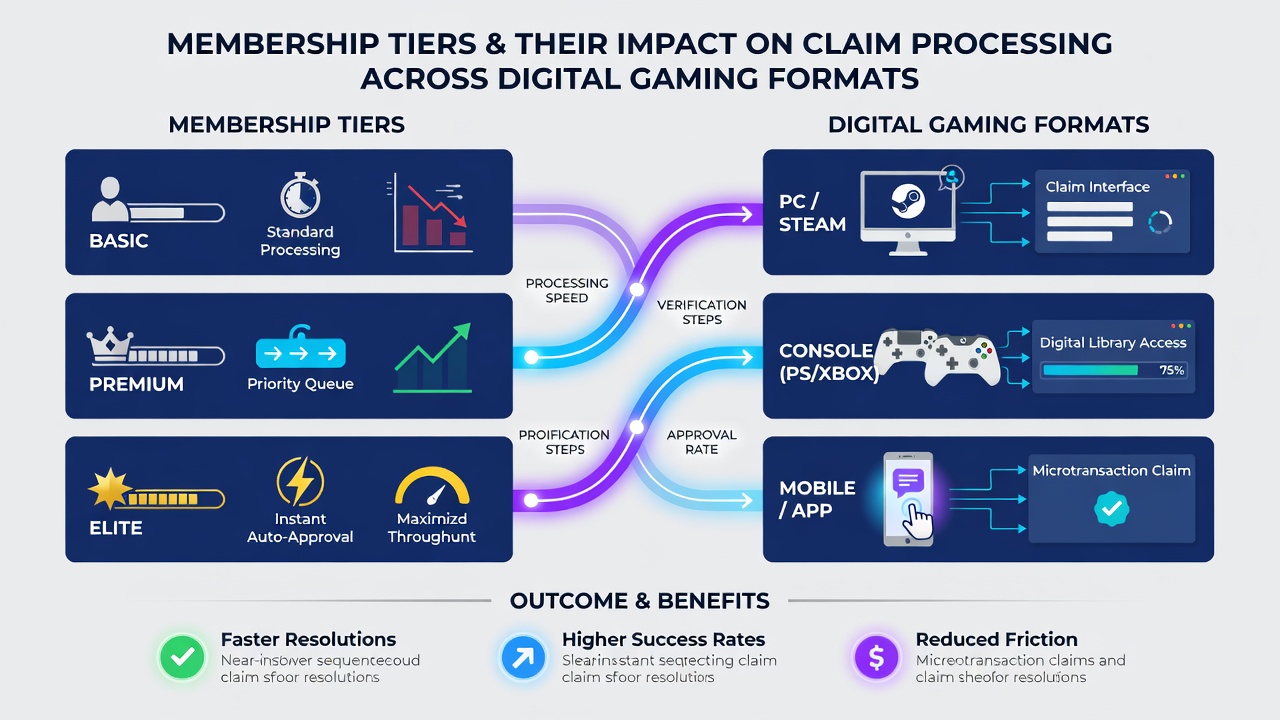
Digital gaming platforms organize player access through structured membership tiers that segment users according to deposit volume, play frequency, and account tenure, and these divisions directly shape how claims move through verification and payout systems. Observers note that higher tiers often receive expedited reviews because automated protocols flag their transactions with priority routing, whereas entry-level accounts encounter additional manual checks that extend timelines.
Research from industry reports shows tiered systems emerged as platforms scaled operations in the mid-2010s, and they now appear consistently across slots, table games, and live dealer environments. Data indicates that claim processing speed correlates with tier status in measurable ways, with premium members completing withdrawals in hours rather than days under standard conditions.
How Tier Classifications Determine Processing Protocols
Platforms assign tiers through algorithms that track metrics such as total wagers and account longevity, then apply those labels to trigger specific workflows during claim submission. Lower tiers typically route requests through multi-stage compliance layers that include identity confirmation and source-of-funds verification, while elevated tiers bypass some of those steps via pre-approved status flags. Those who've studied platform operations point out that the difference stems from risk modeling, since frequent high-volume players generate more predictable transaction patterns that reduce the need for repeated scrutiny.
According to figures released by the American Gaming Association, tiered accounts accounted for over sixty percent of processed claims in regulated U.S. markets during the first quarter of 2026, and the association's analysis linked faster resolution rates to membership level rather than game type alone.
Variations in Mobile, Desktop, and Live Dealer Environments
Mobile formats integrate tier data directly into app-based claim interfaces, allowing instant status checks and automated approvals for qualifying users, whereas desktop portals often require separate dashboard navigation that inserts extra confirmation clicks. Live dealer streams add another layer because real-time table interactions generate separate claim categories tied to session bonuses or progressive jackpots, and tier status influences whether those claims merge with standard withdrawal queues or receive dedicated handling.
Studies compiled by Canadian regulatory bodies reveal that mobile claim approvals for top-tier members averaged under four hours in monitored jurisdictions, while desktop equivalents for the same tier extended to six hours because of additional browser-session validations. The difference narrows at lower tiers, where both formats impose comparable multi-hour holds regardless of device.
June 2026 Updates to Tier-Linked Claim Systems
Platform operators introduced refined algorithms in June 2026 that further aligned tier benefits with cross-format claim handling, and these changes allowed mobile and live dealer claims to share unified verification pools for premium users. Figures from the same period indicate a measurable drop in average processing times across formats, particularly for accounts that maintained consistent activity across both automated reels and real-time dealer tables. Regulators in multiple regions documented the adjustments through routine compliance filings, noting that the updates reduced redundant checks without altering core security requirements.
One study from an Australian research consortium tracked claim flows before and after the June rollout, and it found that tier-three and tier-four members experienced the largest gains in efficiency when claims originated from mixed-format sessions. The data highlighted how unified ledgers reduced handoff delays that previously occurred when mobile deposits converted to live table play mid-session.
Security and Compliance Considerations Across Tiers
Every tier level incorporates baseline fraud detection measures, yet higher classifications leverage accumulated behavioral data to streamline those same safeguards. Platforms maintain audit trails that record each claim stage, and tier status determines whether human reviewers intervene or algorithmic approvals suffice. Those monitoring regulatory trends observe that compliance costs decrease as tier volume rises because fewer accounts require resource-intensive manual intervention.
External audits conducted under frameworks established by European gaming oversight groups confirm that tier-based routing maintains consistent security standards even as processing accelerates. The audits emphasize documentation protocols that remain identical regardless of speed, ensuring that faster approvals do not compromise record-keeping obligations.
Conclusion
Membership tiers function as operational filters that shape claim processing timelines across digital gaming formats, and their influence appears consistently in mobile, desktop, and live dealer environments. Data collected through mid-2026 demonstrates measurable differences in resolution speed tied directly to tier placement, with platforms continuing to refine these systems in response to regulatory and technological shifts. The structure supports efficient resource allocation while preserving verification standards that apply uniformly across player categories.